


- S1
Principal corridors · indicative · not to scale
Issues / Addressing Human Rights ViolationsIssue · Addressing Human Rights ViolationsThe further you travel for work,the further your rights must travel to reach you.
Migration changes geography, not humanity. Workplace rights do not evaporate when a worker crosses a province or a national border.Whether navigating cross-border corridors into Thai apparel factories or remote overseas mining enclaves, migrant workers face a common reality: stacked dependence. When language barriers, recruitment debt, physical isolation, and document control converge, a worker loses the practical ability to refuse harm, seek help, or reach justice.
01 · Two corridors, one system of dependenceThe mechanisms of exploitation differ across borders and industries, but the structural outcome is identical: extreme vulnerability manufactured by design.
01 · journey beginsUninformed Departure02 · cost bindsRecruitment Debt03 · distance closesIsolated Workplace04 · no exitMissing RemedyWithout correction, missing remedy sends the next worker back into the same corridor.Global reference · ILO · 2022 estimateThe International Labour Organization estimates that 167.7 million international migrants were in the labour force of their destination countries in 2022, representing 4.7% of the global labour force. Of these, 155.6 million were employed and 12.1 million were unemployed.
167.7MInternational migrants in destination labour forces · 20224.7%Of the global labour forceILO · Global estimates on international migrants in the labour force · fourth edition
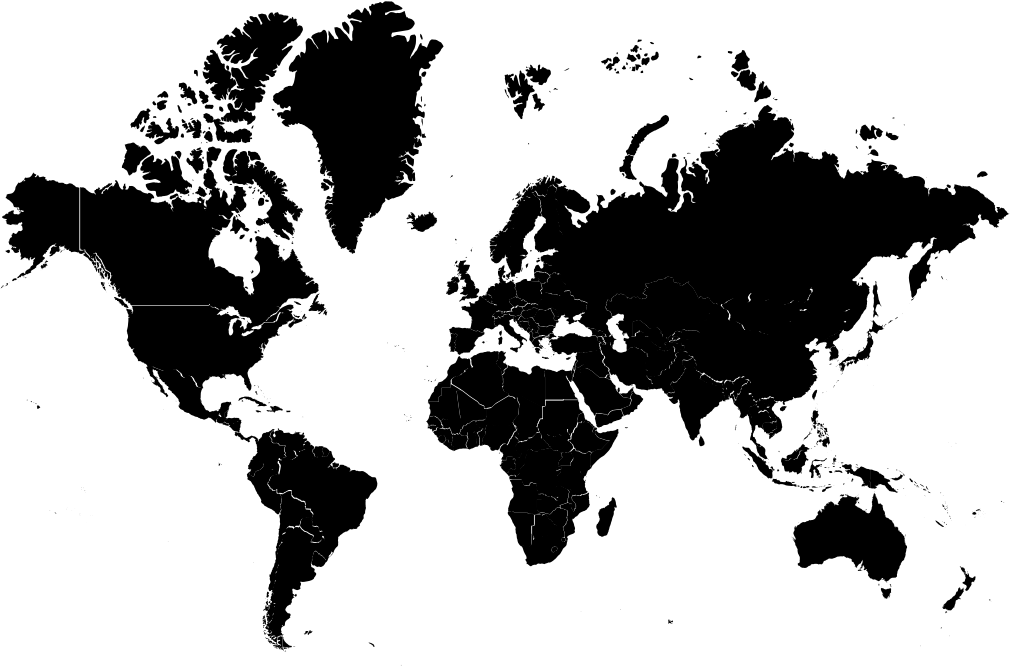
Field map · two corridorsDifferent routes. The same architecture of dependence.
Both routes remain visible on one map. Choose a line to follow what happens between departure, the workplace and the point where remedy should have been reachable.
 Broker fee / paid before first wage
Passport / access not assured
Factory gate / dormitory boundary
Remote mining enclave / endpoint under verification
Broker fee / paid before first wage
Passport / access not assured
Factory gate / dormitory boundary
Remote mining enclave / endpoint under verification
Indicative routes · not to scale. Corridor B’s destination is intentionally not placed until the field location is verified.
01One issue, different migration systemsThe same worker. Different systems around them.
China · Internal movement, divided access.
China’s National Bureau of Statistics counted 301.15 million nongmingong in 2025. Of these, 180.06 million worked outside their home township and 67.65 million moved across provinces. These figures describe a specific rural-household-registration category, not every person who moves within China for work. The scale nevertheless makes one point unavoidable: a worker may never cross a national border while contracts, wage evidence, work-injury claims, social insurance, public services and family support still have to cross administrative and employment boundaries.
S2Southeast Asia · Employment organised as a corridor.
Cross-border work is rarely a relationship between one worker and one workplace alone. Recruiters, sub-agents, documentation processes, transport, employers, labour providers, accommodation and government systems can each control one part of the journey. A promise may be made in the place of origin, altered after arrival and disputed in a third location. Responsibility fragments across institutions while the worker experiences one continuous journey.
 S3
S3Thailand–Myanmar · A focus corridor.
The Myanmar–Thailand route is one of the most significant migration corridors in the Asia-Pacific region. As of 1 January 2025, official Thai data cited by IOM recorded 2,270,382 registered migrant workers from Myanmar, representing 68% of registered migrants in Thailand. Registration is not the whole picture: IOM also estimated that at least 1.7 million Myanmar migrants in Thailand were in irregular situations in July 2024. Economic need, safety concerns and political instability shape movement along the corridor, while language, documentation, recruitment costs, health-care access and precarious employment shape what happens after arrival.
S4Status changes rights pathwaysMigrant workers and refugees should not be collapsed into one category. In 2025, Thailand opened legal employment to long-staying refugees from Myanmar in temporary shelters along the border. In June 2026, official identification cards began to be issued to this group, covering a population of about 80,000 forcibly displaced people. This is a distinct population from registered migrant workers. It nevertheless demonstrates a shared rights lesson: documentation and legal access to work can change a person’s ability to move, use services, earn independently and resist exploitation.
Social protection gapThailand had nearly four million registered migrant workers in 2025, according to Ministry of Labour data cited by the ILO, but only about one in four was covered by the Social Security Fund. Registration, employment and effective access to protection are therefore not the same achievement.
02Our three-part interventionTechnology creates a pathway. Human networks restore the right.
Technology alone cannot deliver justice. Tech is a pathway to connect — human networks restore the right.
01 · Individual journey navigation Local-Language Hotlines
Providing direct, dialect-sensitive hotline support that maps the worker’s entire journey — from pre-departure promises to frontline workplace realities — resolving individual grievances in real time.
02 · Integrated support Local Support Resources Networks
Connecting hotline cases directly to an active, on-the-ground safety net that brings together legal aid, social workers, public health professionals, and non-judicial grievance mechanisms.
03 · “Golden cases” Multi-Stakeholder Advocacy
Transforming real frontline evidence (“golden cases”) into systemic leverage — bringing brands, factory management, mining operators, and policymakers together to overhaul recruitment practices and dismantle discriminatory workplace filters.
Data & story proof pointsDraft evidence slots · not for publicationData placeholder 01 18,000+ / XX languages
Suggested metric: total volume of migrant-worker cases carried, language lines operated, and corridors covered. Example only: 18,000+ migrant-worker field cases handled across XX languages and dialects across Asian supply-chain corridors since 2007.
Story placeholder 01 · requires verification Myanmar apparel worker in Thailand
A Myanmar apparel worker in Mae Sot faced sudden dismissal and document retention after asking about illegal recruitment-fee deductions. Calling our Burmese hotline enabled our local team to intervene directly with factory management, securing full wage repayment, passport return, and safe re-employment.
Story placeholder 02 · requires verification Overseas Chinese mining worker
An overseas Chinese miner injured on a remote site was left without medical coverage or passport access. Through direct referral to local legal aid and brand-level engagement, we established employer liability, funded medical treatment, and secured compensation without loss of status.
Data placeholder 02 $X.X Million
Suggested metric: total recruitment fees reimbursed or financial restitution secured. Example only: over $X.X million in illegal recruitment fees and withheld earnings directly restored to migrant workers’ hands.
03Harm does not fall evenlyThe same journey is not equally safe for everyone.
Migration status rarely acts in isolation. Gender, disability, health status, ethnicity, language, age, and caregiving responsibilities dictate where people work, the forms of dependence they carry, the violence they face, and whether a remedy is reachable.
The core question is not how many labels a worker carries—it is how many systems can deny the same person safety, dignity, and remedy at once.01 · Female Migrant WorkersMany women are concentrated in domestic care, agriculture, and processing—informal sectors where labour inspection rarely reaches, and where the workplace frequently doubles as their living quarters.
Intersecting RisksGender-based violence, harassment, pregnancy discrimination, and unpaid care responsibilities converge with employer-controlled housing, identity documents, and visas.
The BarrierReporting abuse often means risking employment, shelter, and physical safety simultaneously.
Field EvidenceIn Thailand, over 125,000 registered migrant domestic workers—predominantly women from Myanmar and Lao PDR—work in private households beyond the reach of standard workplace inspections.
02 · Migrant Workers with DisabilitiesDisability may precede migration, arise during hazardous journeys, or result from occupational injuries on the job.
Intersecting RisksInaccessible recruitment materials, contracts, transport, housing, and grievance channels leave disabled workers exposed. An occupational injury can instantly wipe out income, housing, legal status, and healthcare access all at once.
The BarrierIncreased vulnerability stems not from disability itself, but from attitudinal, environmental, and institutional barriers built into the migration system.
03 · Female Migrant Workers with DisabilitiesGender and disability do not merely stack—they create compound, distinct barriers to disclosure and justice.
Intersecting RisksA worker may rely entirely on an employer, partner, carer, or interpreter for basic mobility, communication, and access to services—even when that individual is the source of abuse.
The BarrierA service is not survivor-centred if the survivor cannot enter the building, communicate in private, or make independent choices.
System RequirementReporting channels must offer accessible formats, independent communication support, confidential spaces, and disability-inclusive legal and health referrals.
Tech is a part of solutions, but not the solution itself. A hotline connects the call — a trusted local network restores the right. Make rights travel with the worker.
04What movement can take awayVulnerability is produced, not carried.
Movement can reduce the resources people use to resist harm: familiar relationships, stable housing, savings, knowledge of institutions, control of documents, access to care and the practical ability to refuse, leave or begin again. Those losses may be temporary or profound. They are greatest when movement is shaped by debt, family obligation, insecurity, conflict or displacement.
Vulnerability is not an essence carried by migrant workers. It is a condition produced when movement reduces the resources needed to resist harm — and institutions turn that loss into leverage. Arrangements, unlike identities, can be changed.
05Choice under pressureVoluntary or forced is not the whole story.
Migration is not adequately described as either voluntary or forced. A person may pursue opportunity, respond to family obligation, borrow against an expected wage, lose a livelihood, move because remaining is unsafe, or experience several of these conditions at once. A person may choose to move without having had a meaningful choice about the conditions that made movement necessary.
This distinction matters in the Thailand–Myanmar corridor. Not every Myanmar worker is a refugee, and not every worker moved because of armed conflict. But conflict, insecurity and livelihood pressure cannot be treated as background noise when they shape the resources a worker has before recruitment even begins.
06What the field has taught us01Rights do not weaken with distance. Access to them can.
Labour rights do not become smaller when a worker crosses a province or a border. But language, unfamiliar institutions, cost, status and physical distance can make those rights harder to understand, exercise and enforce.
02Exploitation can begin before employment begins.
Recruitment fees, misleading promises, travel debt and document arrangements can shape the employment relationship before a worker reaches the workplace or earns the first wage.
03Dependence stacks.
When one relationship controls income, accommodation, transport, documents and migration status, losing the job can mean losing several foundations of life at once.
04Responsibility fragments while the worker remains whole.
Recruiters, sub-agents, labour providers, employers, dormitory operators and buyers may each hold one part of the arrangement. The worker experiences all of them as one journey, but may be told by each actor that the problem belongs somewhere else.
05Remedy must be able to travel.
A complaint mechanism that works only while the worker remains at the workplace may disappear at the moment it is most needed — after dismissal, relocation, return or loss of status.
07How distance becomes leverageFive arrangements. One tightening grip.
LEVER 01The paid entrance
A worker pays fees or related costs to secure the job. Debt makes losing the job more dangerous and leaving it more expensive.
LEVER 02The altered promise
The wage, role, location, hours or deductions differ from what was explained before departure, but the worker has already paid, travelled or surrendered other opportunities.
LEVER 03The bundled dependence
Work, accommodation, transport, documents and — in some cross-border programmes — residence status are tied to the same employer or intermediary.
LEVER 04The divided responsibility
Dispatch, outsourcing and recruitment paperwork separates the entity directing the work from the entities formally responsible for wages, insurance, injury or recruitment conduct.
LEVER 05The costly complaint
Language barriers, unfamiliar systems, high process costs and fear of retaliation, dismissal or immigration consequences turn an ordinary grievance into a decision about survival.
 S6
S6The gate may be open. The debt, the document and the dependence can still be the gate.
08A human-rights and labour-rights issueMigrant workers remain workers first.
International labour standards apply to workers regardless of nationality or migration status unless a standard explicitly provides otherwise. Migrant workers therefore remain workers first: entitled to fundamental rights at work, including freedom of association and collective bargaining, freedom from forced labour and discrimination, and a safe and healthy working environment.
Fair recruitment is part of that rights framework. The ILO principle is clear: workers should not be charged, directly or indirectly, in whole or in part, recruitment fees or related costs. When the price of obtaining a job is shifted to the worker, the employment relationship may begin as a debt relationship.
Retention of an identity document does not, by itself, establish forced labour. But depriving a worker of ready access to a passport or identity document restricts freedom of movement and increases the risk of coercion. Deception, restriction of movement, threats, withheld wages, debt bondage, abusive living conditions and document retention are among the indicators that should trigger closer investigation — especially when several appear together.
Laws, migration systems and available remedies differ across jurisdictions. The rights standard on this page is therefore not a substitute for local legal advice. It is a test of the arrangement: can the worker understand the terms, keep control of personal documents, refuse or leave the work, organise with others, report harm safely and obtain a remedy that survives movement?
09Follow the worker through the whole migration pathwayFive checkpoints where rights hold — or break.
S7Diagram slot · the whole migration pathway · awaiting artwork
RecruitmentWho made the promise? What fees and related costs were charged? Was the contract accurate, understandable and provided before commitment or departure?
Journey and arrivalCan the worker access personal documents? Are transport, accommodation, registration and status arrangements transparent? Did the terms change after the worker had already incurred costs?
At workAre wages, hours, deductions, safety, social protection and freedom of association protected equally? Can the worker communicate in a language they understand?
Leaving and returningCan the worker end the employment relationship, retrieve wages and documents, leave accommodation safely and pursue a claim after moving or returning home?
When harm occursIs there a confidential, multilingual and non-retaliatory reporting route? Can local organisations, worker representatives and public institutions support evidence, referral and follow-up across locations?
10A single-issue remedy is not enoughOne person, carrying all of it at once.
Calls from migrant workers often carry a signature: the problem is not only the wage. It is the wage plus the dormitory, the injury plus the recruitment debt, the complaint plus the question of where to sleep or whether the worker can remain lawfully if it goes wrong.
A remedy that answers one layer and leaves the rest is not a remedy; it is a receipt.
Our case work follows the whole position, not the single symptom — because the person calling is not a wage issue standing next to a housing issue standing next to a migration issue. They are one person, carrying all of it at once.
11Why supply-chain responsibility begins before the factory gateDue diligence has to follow the whole recruitment corridor.
A workplace may never directly collect a recruitment fee or retain a document, yet still benefit from a recruitment chain that does. Responsibility cannot begin only when a worker enters the factory. It must reach recruiters, sub-agents, labour providers, transport, accommodation, contract substitution and deductions from wages.
A zero-recruitment-fee policy is not proved by the wording of a supplier contract. It is proved by the worker’s experience: what did the worker actually pay, to whom, at which stage, with what receipt, and what happened when the cost was discovered? Where workers have paid, remedy may require reimbursement as well as correction of the recruitment system.
For brands and buyers, due diligence therefore needs to follow the whole recruitment corridor and preserve access to remedy after a worker has left the site or returned home.
12Issue in Action · Handshake Worker’s HotlineRights that travel need support that travels.
For migrant workersProvide accessible, multilingual routes to raise concerns; follow the full position rather than requiring the worker to separate one experience into institutional categories.
For women and survivors of violenceProvide confidential, survivor-centred and non-retaliatory reporting, safe contact planning, women-led referral options and support that does not make employment or housing the price of disclosure.
For workers with disabilitiesOffer accessible formats and channels, independent communication support, reasonable accommodation and disability-inclusive referral, without allowing an employer, partner or carer to replace the worker’s own decision.
For workers with health needsProtect confidentiality, separate health information from employment decision-making, and support continuity of testing, treatment and referral across employers and locations.
For workplacesReview recruiters, contracts, deductions, document practices, accommodation, health-data practices and grievance systems; identify where dependence becomes leverage and where responsibility has been outsourced.
For local resource networksConnect worker organisations, migrant resource centres, legal support, interpreters, health services and public institutions so that referral leads to a person who can act.
For supply chains and brandsTrace recruitment beyond the direct supplier, investigate worker-paid costs, keep remedy open across borders and use case evidence to correct purchasing, recruitment and oversight systems.
▣ History note: Inno’s earlier Home&Away programme, launched in 2012, worked with migrant-worker families on the effects of separation and the communication challenges carried by labour migration. Its archived public page reports 2,325 families reached, 29,097 beneficiaries and 8,156 calls from migrant-worker families. These figures should remain historical and be published with their reporting period, definitions and underlying institutional record; they should not be presented as current operations.
Checkpoint · do rights travel in supply chains?Five checks before a corridor can be called legitimate.
Any legitimate migration and employment corridor must satisfy five basic checks. Fail one, and migration turns into forced dependence:
Zero Recruitment Fees?
Are job costs fully borne by the employer, or passed down to the worker?
Document Control?
Does the worker retain immediate, independent access to their passport and visa?
Understandable Contracts?
Is the contract provided in the worker’s native language before departure?
Unrestricted Movement?
Can the worker safely leave dormitories, camps, and workplaces during non-working hours?
Reachable Remedy?
Is there a trusted, native-language grievance channel that operates without fear of retaliation or deportation?
Advocacy checkpoint · not a legal determination. Applicable law and individual facts still require review.
Make rights travel with the worker.