


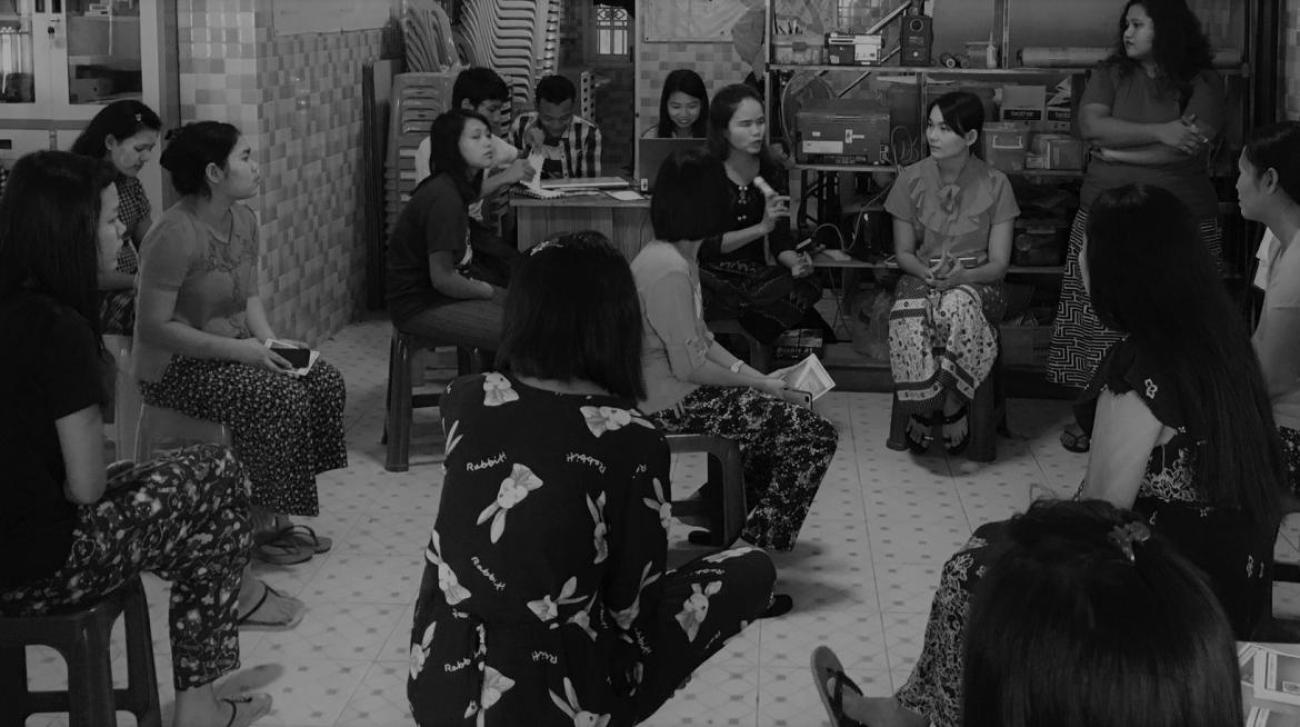
 Our Work / End Gender-based ViolenceLong-term programme Field response · systems change Preview image reference · UNOPS / United Nations Myanmar · 2021A gender equality programme · a lens across Inno
Workplace power is never gender-neutral.
End Gender-based Violence changes the conditions that turn gender into disadvantage, silence and harm. We work with women workers, local organisations and workplaces—from employment and care to leadership, safety and remedy.
Under the gender lens 03 / 04Who is heard?
Women may be essential to production while remaining furthest from leadership, worker representation and the decisions that shape their work.
One programme. Two roles.
End Gender-based Violence has its own field of action, but it also changes how Inno reads every workplace. A gender lens is not confined to cases carrying a GBV label.
As a programme Change conditions. Respond to harm.
Connect women workers’ leadership, workplace change, safe reporting, local support and remedy—from employment and care to violence and harassment.
Across Inno Make gender visible everywhere.
Apply a gender and intersectional lens across HS, EQ and FH. In Handshake, this includes a dedicated gender line as a safer route into support.
What EV seesGender is converted into workplace power.
Gender does not produce disadvantage by itself. Workplace decisions turn gender, pregnancy, care, migration, disability and health status into judgements about cost, reliability, authority and who can be replaced.
Starts before work Entry and progression
Marriage, pregnancy, age and gender assumptions can shape recruitment, pay, training, promotion and who is seen as worth investing in.
Assigned at work Care and health
Pregnancy, breastfeeding, reproductive health and unpaid care are treated as personal inconvenience instead of questions of workplace design and responsibility.
Restricted at work Voice and leadership
Women may be essential to production while remaining underrepresented in decisions, worker leadership and the systems that define workplace priorities.
Enforced through power Violence, harassment and remedy
Dependence on a supervisor, contract, income, accommodation or migration status can make refusal, disclosure and access to support more dangerous.
EV asks not only what happened to one person, but what workplace conditions made the harm predictable—and how those conditions can be changed.
Programme practiceWhat EV works to change.
The programme joins community knowledge, local response capacity and workplace responsibility. No single training, policy or reporting channel can do that work alone.
Workstream 01
Protection, support and remedy
A dedicated gender line within Handshake is one practical route into confidential intake, risk and consent assessment, local case support, referral, remedy and anti-retaliation follow-up.
Confidential, multilingual intake Consent and safety planning Local support and trusted referral Remedy and anti-retaliation follow-upWorkstream 02
Women workers as agents
Support women workers to define the issues, build leadership, express priorities and shape the changes intended to affect them.
Worker leadership Rights and options Community-defined prioritiesWorkstream 03
Workplace systems and power
Move gender equality from a policy statement into recruitment, progression, care, health, participation, prevention and accountability.
Gender-responsive practice Care and reproductive health Participation and accountabilityWorkstream 04
Local response networks
Strengthen the women's organisations, legal, psychosocial, shelter, health and community relationships that make support possible beyond a workplace procedure.
Frontline organisations Trusted referral Local case supportWorkstream 05
Gender across every programme
Bring gender and intersectionality into labour-rights cases, disability inclusion, health discrimination and every other workplace entry point.
HS · dedicated gender line and gendered labour risk EQ · disabled women and participation FH · gender and health stigmaHow the programme operatesLong-term work. Operating and evolving.
End Gender-based Violence grows from years of listening to women workers and working across employment access, care, health, leadership, workplace mechanisms and GBVH. Today it connects two levels of practice: gender-specific routes—including Handshake’s dedicated gender line and local case support—and a gender and intersectional lens across Inno’s programmes. One channel, one training or one partnership is never the programme in full. The work keeps evolving as cases reveal where power, protection and remedy still fail.
1 in 5people in employment have experienced violence or harassment at work. Women face particular forms and risks.½of people who experienced violence or harassment told anyone about it.Global reference · ILO–Lloyd's Register Foundation–Gallup survey, 2022Gender equality must change who holds power—not only what the policy says.